Meet the team: Deputy CEO, Andrew McDermott
Tell us a bit about yourself
I’ve spent more than 30 years working in the ceramics industry, so it’s a sector I know incredibly well and have enjoyed being part of throughout my career. The first 16 years of my career were in technical roles within ceramic production, starting with PhD research and progressing through to Technical Manager positions. Along the way, I worked across a range of ceramic sectors, including technical ceramics, clay roof tiles, and wall and floor tiles.
For the past 14 years, I’ve been with Ceramics UK, where I’ve had the opportunity to support and represent the industry on a wider scale. Combining hands-on technical expertise with industry advocacy has given me a broad perspective on the challenges and opportunities facing the ceramics sector today.
What’s your role, and what do you enjoy most about it?
As Deputy CEO of Ceramics UK, I work closely with our members, government, regulators, and other key stakeholders to ensure the industry’s voice is heard on the policy areas I lead and oversee, particularly energy policy, decarbonisation, and industrial policy.
I also chair a number of cross-sector groups that bring together organisations from across the foundation industries, including the Energy Intensive Users Group (EIUG) and the Emissions Trading Group’s ETS and Net Zero Working Group. These roles provide valuable opportunities to collaborate on shared challenges and help shape policies that support UK industry.
What I enjoy most about the role is the sheer variety. One day I might be discussing energy policy with government officials, the next I could be drafting a consultation response, and the day after that I might be visiting a member company to talk through an issue or see an exciting new innovation they’ve implemented. No two days are ever quite the same, which makes the job both interesting and rewarding.
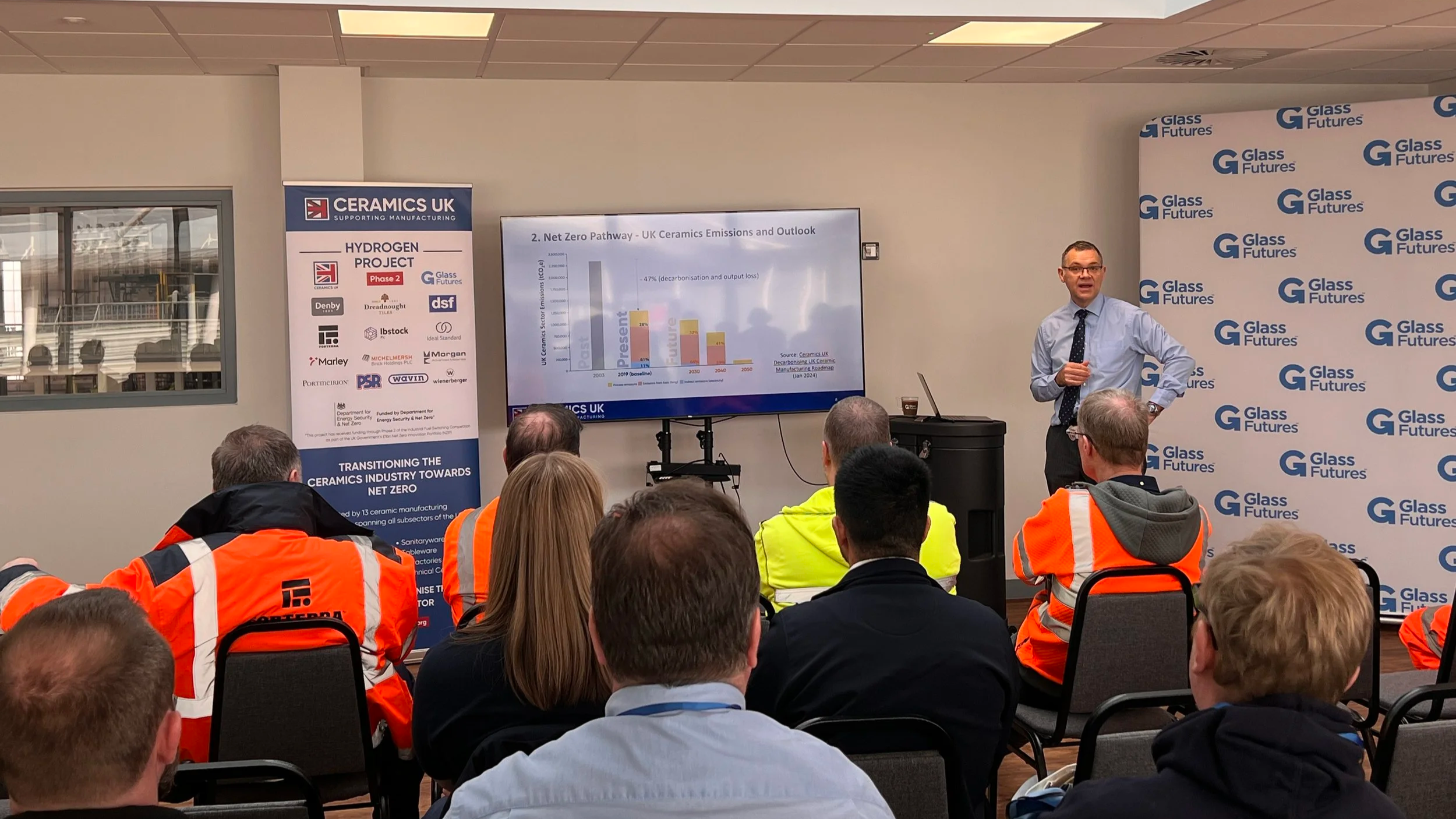
Hydrogen Project Site Visit
Is there a project or moment you’re most proud of?
There are two achievements that stand out for me.
The first is securing and leading a £6 million hydrogen programme for the ceramics sector. What makes me most proud of this project isn’t just its scale, but everything that was needed to make it happen. It involved developing the original proposition, securing government funding, bringing together more than a dozen member companies along with multiple suppliers and contractors, managing a significant budget, and delivering a technically complex programme despite a number of challenges along the way.
It also marked an important step for Ceramics UK, moving us beyond policy advocacy and into the practical demonstration of a technology that could play a key role in the sector’s future. It’s especially rewarding to see that one of our members, Wienerberger UK has since taken this work forward and is now implementing hydrogen firing in production at its Denton site.
From a policy perspective, I’m particularly proud of our work on carbon leakage protection in 2014, 2019 and 2025. These efforts have delivered tens of millions of pounds of value for our members. What I value most about this achievement is that success wasn’t simply about making policy arguments. It required a deep understanding of members’ commercial realities, building a strong evidence base, challenging established government thinking, and consistently making the case over many years. Seeing that persistence translate into tangible benefits for the industry has been incredibly satisfying.
As Deputy CEO, you spend a lot of time advocating for the industry. What’s one misconception people outside ceramics have about the sector?
One very common misconception is that ceramics is a traditional industry that hasn't changed very much over time. Think potters’ wheels and bottle kilns.
While our industry benefits from centuries of manufacturing heritage, modern ceramics production is highly technical, innovative, automated, and increasingly data-driven. The sector produces everything from construction products and advanced refractories to components used in aerospace, healthcare, energy generation, and electronics. It's an industry that is constantly evolving.
Why is sustainable growth such an important focus for Ceramics UK and its members?
For our members, sustainable growth means remaining internationally competitive while transitioning to lower-carbon manufacturing.
The ceramics industry has already made significant improvements in energy efficiency, but further decarbonisation presents major challenges because many of our processes require very high temperatures and currently rely heavily on natural gas combustion.
Over the coming years, sustainable growth will require a combination of technological solutions. These include continued improvements in energy efficiency, electrification, greater use of bioenergy, carbon capture technologies, and the development of alternative fuels such as hydrogen.
One exciting area of work has been our involvement in the hydrogen project. This has helped us understand how hydrogen can be safely and effectively used in high-temperature ceramic manufacturing processes. While there is no single route to net zero for the sector, practical demonstrations are essential for reducing uncertainty and informing future investment decisions.
The key challenge is ensuring that the transition is both environmentally and economically sustainable. Our members need access to cost-effective low-carbon energy and supportive policy frameworks if we are to decarbonise by innovation and investment rather than deindustrialisation.
Since joining Ceramics UK, do you have a particular highlight?
One of the highlights has been the opportunity to work with such a diverse group of member companies and to see the incredible breadth of products they manufacture.
I've also enjoyed helping to raise the profile of the sector with policymakers and ensuring that ceramics has a seat at the table when important decisions affecting UK manufacturing are being made.
What’s the most important lesson you’ve learned in your career so far?
Never underestimate the importance of listening.
Whether you're working with manufacturers, policymakers, researchers, or colleagues, the best outcomes usually come from understanding different perspectives and finding practical solutions that work for everyone involved.
What’s your favourite thing about working for Ceramics UK?
The people.
The sector is full of knowledgeable, passionate, and resilient individuals who genuinely care about their businesses, their employees, and the products they make. It's a privilege to work with them and help support the industry's future success.
How would you describe the team in three words?
Dedicated. Supportive. Superstars!
Can you share a fun fact about yourself that might be surprising?
I can play a trumpet (although probably not that well anymore)
Do you have a go-to tip or hack that helps make your day run smoothly?
Start each day by identifying the one or two things that will make the biggest difference if they're completed. It's easy to get distracted by endless emails and meetings, so having a couple of clear priorities helps maintain focus.
Do you have a fun fact about the industry?
Ceramics have a whole range of unique properties, including being incredibly strong in compression. A china teacup under each wheel can support the weight of a double-decker bus!